Architecture
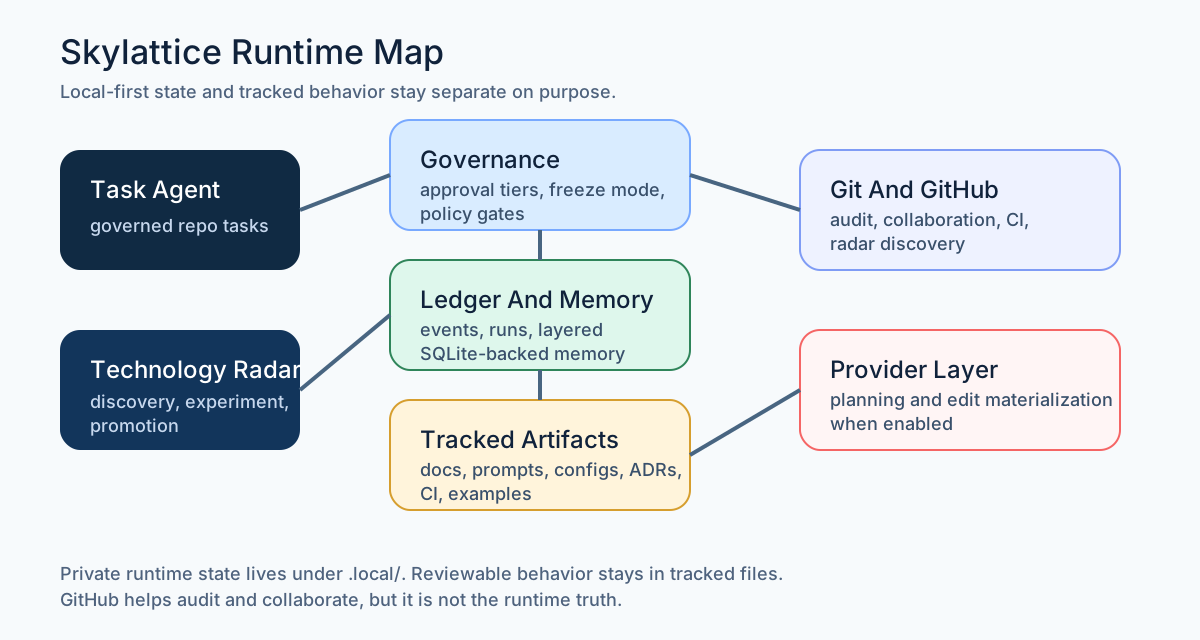
Skylattice is a local-first runtime with a new dual-surface product shape. If you want the operator-facing quick start and public-safe sample outputs first, start from the landing page and proof.md.
Current Shape
Skylattice now has two cooperating product surfaces:
- local runtime: the authoritative task-agent and technology-radar executor
- hosted web control plane: sign-in, pairing, command intent, onboarding, and lightweight mirrored summaries
The local runtime still owns the executable workflows:
task-agent: constrained repo work and GitHub triagetechnology-radar: GitHub open-source discovery, bounded experimentation, guarded promotion, and rollback
Those workflows still share:
- local SQLite state in
.local/state/skylattice.sqlite3 - append-only ledger events
- layered memory storage
- governance policy and approval logic
- repo workspace and git adapters
Main Components
Kernel
src/skylattice/kernel/
- loads tracked defaults, local overrides, and env overlays
- defines stable agent identity, user model, relationship model, mission, and runtime snapshot
- provides a durable summary surface for CLI and API inspection
Runtime Layer
src/skylattice/runtime/
TaskAgentServiceis the top-level facade used by CLI and API- the same service facade now also supports an authenticated local web-bridge API plus a local hosted-app connector path
- task runs and radar runs both create shadow entries in the generic
runstable so ledger and memory can reference one shared run id surface RuntimeDatabaseowns the tracked schema for task, ledger, memory, and radar tablesload_task_validation_policy()loads tracked validation commands fromconfigs/task/validation.yamlload_radar_config()also loads tracked radar schedule intent fromconfigs/radar/schedule.yamlload_radar_config()also loads tracked radar provider intent fromconfigs/radar/providers.yaml- radar candidates and evidence now persist provider-neutral identity fields alongside current GitHub-shaped compatibility fields
- radar evidence kinds are normalized to provider-neutral taxonomy values on write and read
- validation commands now carry stable ids, expected outputs, and profile membership instead of acting as a flat string allowlist
- local memory review, export, and retrieval ranking stay local-first; public API routes still expose read surfaces while
/bridge/v1adds authenticated, versioned write-safe web operations for the hosted control plane
Task Agent Path
src/skylattice/planning/, src/skylattice/actions/, src/skylattice/providers/
Flow:
- interpret goal
- retrieve ranked profile, procedural, and semantic memory for the current goal
- generate a constrained plan with declared edit modes, tracked validation refs, and bounded GitHub sync context when available
- gate repo and external writes
- execute deterministic text edits or full rewrites through the repo workspace adapter
- verify results with tracked validation commands and local edit invariants
- expose retry diagnostics for blocked or halted steps, then resume only with explicit operator action
- write episodic and procedural memory
The planner can see a bounded memory_context, but memory retrieval does not widen permissions or validation scope.
Resume behavior is also bounded: blocked and halted steps expose structured recovery metadata, and GitHub sync steps try to reuse prior remote artifacts instead of blindly duplicating them.
GitHub context is similarly bounded: planner prompts may see recent open issues and PRs, PR sync now performs an observe-tier preflight, and recovery summaries expose remote target state without turning GitHub into runtime truth.
Current task edit modes:
rewritereplace_textinsert_afterappend_textcreate_filecopy_filemove_filedelete_file
Technology Radar Path
src/skylattice/radar/
Flow:
- discover repositories through a stable source interface
- score candidates against tracked topics, freshness, activity, releases, and capability gaps
- record semantic memory for shortlisted candidates
- create repo-contained spike branches under
codex/radar-* - validate spikes with tracked checks
- promote at most one candidate per run to
mainthrough a guarded allowlist - update
configs/radar/adoptions.yamland promotion logs - support rollback through explicit promotion records
Radar now also has tracked local schedule intent, tracked provider intent, plus Windows-first schedule rendering and an operator runbook, but it still delegates actual recurring execution to the operating system instead of a resident Skylattice worker.
Data Stores
Tracked
configs/agent/defaults.yamlconfigs/policies/governance.yamlconfigs/task/validation.yamlconfigs/radar/*.yaml- prompts, skills, docs, ADRs, eval specs
configs/radar/adoptions.yamlas a reviewable behavior-change registry.github/workflows/ci.ymland GitHub templates as public collaboration behavior
Local Only
.local/state/skylattice.sqlite3.local/memory/.local/work/.local/logs/.local/overrides/
Maintainer Maps
Execution Map
- CLI entry:
src/skylattice/cli.py - local API entry:
src/skylattice/api/app.py - local connector entry:
src/skylattice/web/connector.py - hosted app workspace:
apps/web/ - top-level runtime facade:
src/skylattice/runtime/service.pyviaTaskAgentService.from_repo() - task-agent chain: planner/provider -> workspace/git/github adapters -> validation -> ledger and memory
- radar chain: discovery source -> scoring -> experiment -> promotion or rollback -> ledger and memory
- shared state surface: SQLite tables in
.local/state/skylattice.sqlite3plus tracked config underconfigs/
Truth-Source Map
- tracked product and policy truth:
README.md,docs/*.md,docs/adrs/*.md,configs/agent/defaults.yaml,configs/policies/governance.yaml,configs/task/validation.yaml, andconfigs/radar/*.yaml - tracked prompt intent:
prompts/system/ - runtime orchestration truth:
src/skylattice/runtime/,src/skylattice/radar/,src/skylattice/actions/, andsrc/skylattice/memory/ - tracked prompt files under
prompts/system/now own the human-readable mission, planner, editor, prompt-template, and connectivity-smoke instructions;src/skylattice/providers/openai.pyonly loads those required files, interpolates templates, checks for missing prompt assets, applies JSON-schema constraints, parses responses, and enforces edit modes in runtime code prompts/system/reflector.mdremains a tracked future-facing asset until a reflection runtime path exists- local runtime truth:
.local/state/,.local/memory/,.local/logs/,.local/work/, and local radar validation exports under.local/radar/validations/ - remote advisory truth: GitHub PR, issue, repository, and release state can guide planning and recovery, but does not replace local runtime state
- hosted control-plane truth: the web app may store accounts, pairing state, command records, and lightweight summaries, but it does not replace local runtime, local memory, or local ledger truth
- production-like Hosted Alpha deployments now refuse to silently fall back to local-file control-plane state; missing hosted env leaves the app blocked instead of pretending local persistence is a valid live backend
Write-Permission Map
observe: local inspection, status, read-only API access, and advisory GitHub reads- authenticated hosted-app commands still resolve to the same local permission tiers; the browser does not receive a special bypass tier
local-safe-write: reversible writes under approved.local/rootsrepo-write: tracked repository edits, branch creation, and commit steps initiated by task runsdestructive-repo-write: required in addition torepo-writefor trackedmove_fileanddelete_fileexternal-write: push, draft PR sync, and issue-comment sync for task runsradar-experiment-write: bounded spike writes on whitelisted tracked pathsradar-promote-main: bounded direct-to-mainpromotion writes on whitelisted tracked pathsself-modify: policy or autonomy widening, still outside normal automatic flows
Test-Coverage Map
tests/test_smoke.py: task-agent planning, edit materialization, approval gates, recovery, GitHub sync, and CLI/API smoke pathstests/test_memory.py: memory record states, retrieval ranking, review flows, rollback, and export behaviortests/test_radar.py: radar discovery contracts, scoring, scheduling, validation reports, promotion, rollback, and provider-neutral identity behaviortests/test_public_readiness.py: public-safe tracked artifacts, release surfaces, Pages metadata, outreach files, and repo hygienetests/test_web_bridge.py: authenticated bridge routes, local connector config, and hosted control-plane command dispatch scaffoldingtools/run_authenticated_smoke.py: opt-in read-only validation against the live GitHub, GitLab, and OpenAI adapters when operator credentials are present- current test strength is contract and boundary coverage; authenticated end-to-end validation against live OpenAI and GitHub remains intentionally narrower and operator-invoked
Key Boundaries
- GitHub is a source and audit surface, not runtime truth.
- the hosted app is a control plane, not runtime truth
- Task-agent validation commands are constrained to tracked config, profile membership, and declared expectations; they do not grant arbitrary shell execution.
- Current richer repo ops are still text-first and bounded:
create_fileandcopy_fileare routine repo-write steps, whilemove_fileanddelete_filerequire a separate destructive approval. - halted repo and external write steps remain operator-resumed; there is no automatic retry worker
- profile updates, semantic compaction, and procedural dedup stay review-driven local actions; there is no background memory mutation
- Radar promotions are limited to whitelisted tracked paths from
configs/radar/promotion.yaml. src/skylattice/runtime/,src/skylattice/governance/, and core schema paths are intentionally outside the automatic radar promotion path.- The runtime does not depend on GitHub or GitLab to exist, but live radar discovery depends on explicit provider credentials such as
GITHUB_TOKENorGITLAB_TOKEN. - the hosted app may be unavailable while the local runtime remains fully usable; the connector sync path is additive rather than authoritative
- Hosted Alpha is intentionally narrow: Vercel-hosted app, GitHub OAuth, Neon/Postgres control-plane state, and paired local agents rather than hosted execution
Observability
- every task and radar run has ledger events
- task edit steps record their materialized payloads for inspection
- halted and blocked task steps record retry metadata and recovery guidance for
task inspect, CLI status, and the read-only API - memory writes are attached to run ids when applicable
- memory records can be listed, searched, exported, rolled back, and reviewed through the CLI without exposing a write API
- radar promotions persist
promotion_id,source_branch,base_commit,experiment_commit,main_commit, androllback_target skylattice doctorand the public read-only FastAPI routes expose current local state, while the authenticated local bridge API exposes a narrower, versioned command surface for hosted-app integrations